My father moved his arthritic hands across
a row of pocketbooks as if he were a blind
man reading braille. Indeed, his vision was
nearly gone, so he had to lift each purse and
hold it close enough to see it. He unzipped
the pockets, felt the material, measured the
length of every strap. So intent he was on
finding the perfect gift, he might have been
alone in that busy store, save for his daughter,
whom he asked once or twice, What do you
think of this one? Still, the soft-leathered,
cream-colored, mid-sized purse was entirely
his choice. He paid for it with his credit card—
my only job, to sign his good name. Then
he carried that sack containing her present
as if it already held my mother’s wallet and
lipstick, her car keys and pens. And when she
opened his gift on Christmas Day, though he
could hardly see her face, my father knew its
shape by heart, could tell that she was smiling.
Terri Kirby Erickson is the author of six collections of poetry. Her work has appeared in “American Life in Poetry,” The SUN, The Writer’s Almanac, Valparaiso Poetry Review, Verse Daily, and many others. Her awards include the Joy Harjo Poetry Prize and a Nautilus Silver Book Award.

Friday, December 23, 2022

Thursday, December 22, 2022
The Ancestors by Wayne F. Burke
died without a peep; died
with drawers full of
paid receipts and
ink-stained ledgers
of thumb prints that
recorded only
the story of dollars
earned and spent:
the gas station and
the INN--
the car that went from home
to work and back; the
early mornings and late
nights in the cold & dark,
the rolls of nickels
stored in a metal box
along with insurance policies
that never paid enough
to make a difference
in anyone's life.
Wayne F. Burke's poetry has been widely published in print and online. He is author of 8 published poetry collections, one book of short stories, and a non-fiction work titled HENRY MILLER: SPIRIT & FLESH. He lives in Vermont.
Wednesday, December 21, 2022
Abject Colors by Howie Good
My father, in the long days
just after the factory closed down,
would sit staring morosely
at the TV for hours.
Meanwhile, my mother
shut herself up in the bedroom.
I could hear her in there
alternately raving and weeping.
“Love is like a tree,” Victor Hugo said.
I was the kid you saw
crunching through dead leaves.
Howie Good's latest poetry books are The Horses Were Beautiful, available from Grey Book Press, and Swimming in Oblivion: New and Selected Poems from Redhawk Publications.
Tuesday, December 20, 2022
Untitled by Matthew Borczon
A
therapist
says
he
can
hear
the
war
in
my
voice
post
deployment
Matthew Borczon recently retired from the United States Navy Reserve after 20 years of service. He is a poet from Erie, Pennsylvania who has written 17 books of poetry. His most recent book PTSD: A Living Will was released last year from Rust Belt Press. He is a nurse at a plasma donation center and is married with 4 children. He publishes widely in the small press.
Monday, December 19, 2022
Untitled by Matthew Borczon
My
wife
spun
her
wedding
ring
like
a
prayer
wheel
deployment
Matthew Borczon recently retired from the United States Navy Reserve after 20 years of service. He is a poet from Erie, Pennsylvania who has written 17 books of poetry. His most recent book PTSD: A Living Will was released last year from Rust Belt Press. He is a nurse at a plasma donation center and is married with 4 children. He publishes widely in the small press.
Friday, December 16, 2022
Haiku by John J. Dunphy
traffic jam
sound of honks
from overhead geese
John J. Dunphy’s poetry collections include Stellar Possibilities, Dark Nebulae, Bullet Cluster, Zen Koanhead, Old Soldiers Fading Away, pagan rites and Touching Each Tree. He runs The Second Reading Book Shop in Alton, Illinois. Visit his Facebook page to get to know him better!
Thursday, December 15, 2022
Haiku by John J. Dunphy
street corner
panhandler and a passerby share
Iraq war stories
John J. Dunphy’s poetry collections include Stellar Possibilities, Dark Nebulae, Bullet Cluster, Zen Koanhead, Old Soldiers Fading Away, pagan rites and Touching Each Tree. He runs The Second Reading Book Shop in Alton, Illinois. Visit his Facebook page to get to know him better!
Iraq war stories
John J. Dunphy’s poetry collections include Stellar Possibilities, Dark Nebulae, Bullet Cluster, Zen Koanhead, Old Soldiers Fading Away, pagan rites and Touching Each Tree. He runs The Second Reading Book Shop in Alton, Illinois. Visit his Facebook page to get to know him better!
Wednesday, December 14, 2022
Haiku by John J. Dunphy
storefront church
street person leaves wearing
the minister’s winter coat
John J. Dunphy’s poetry collections include Stellar Possibilities, Dark Nebulae, Bullet Cluster, Zen Koanhead, Old Soldiers Fading Away, pagan rites and Touching Each Tree. He runs The Second Reading Book Shop in Alton, Illinois. Visit his Facebook page to get to know him better!
Tuesday, December 13, 2022
Angel in the Snow by Alice G. Waldert
When a letter arrives
with a foreign stamp,
my foster mother
orders me out
where snowflakes fall
like cinder ash.
Plunging backward
into a snowbank,
I become Phaethon
plummeting from the sky
and when I land, the trees
mourn, sagging sisters
burdened by grief.
I make wings with my arms.
My angel flies
above the smokestack
billowing black, while Mutti
burns her secrets.
Alice G. Waldert is a poet and creative nonfiction/fiction writer. Her work has appeared in Arc Poetry Magazine, Misfit Magazine, Prometheus Dreaming, Survivor Lit, and other journals, and she has work forthcoming in the Evening Street Review. In addition, she is working on her first poetry collection about surviving childhood traumas rooted in war. She holds an MFA from Manhattanville College.
Monday, December 5, 2022
Partners by Penelope Moffet
Two wide-mouthed mugs
the color of coffee lightened with cream,
shaped to welcome cappuccino or latte,
purchased years ago from their maker,
Mary Swann. Her loopy signature
sprawls across their undersides,
these wide-hipped mugs
I bought to share
with my next love
late Sunday mornings.
Then he didn’t like coffee.
The mugs nest in the cupboard
face-down until in early morning dark
I pull one out for espresso, nutcream
frothed and steamed and sprinkled with cinnamon
the same orange-brown as the clay.
Each has a tiny chip on its lip.
They sleep together
all night long.
Penelope Moffet is the author of three chapbooks, most recently Cauldron of Hisses (Arroyo Seco Press, 2022). Her poems have been published in The Missouri Review, One by Jacar Press, Natural Bridge, Permafrost, Gleam, Rise Up Review, The Sow’s Ear Poetry Review, The Ekphrastic Review, Gyroscope and other literary journals.
Thursday, December 1, 2022
Over the River and Through the Woods by Russell Rowland
No, Grandmother’s house isn’t there anymore,
nor Grandmother, nor much of the woods.
Nor us seated together. On Facebook
we reminisce about her steamy windows, gold
with light from within, as the bird
and its accoutrements emerged from the oven.
Her apron, how we do remember that apron,
the little smile reminding us to fold
our hands, bow our heads, before digging in.
One day of the year, we felt wholesomeness,
and wondered whether “everything
is going to be all right” was perhaps less
the empty assurance time had made it seem.
And, of course, we went home with leftovers.
I was the one who lived near enough
to touch Grandmother’s cheek in the hospital,
and say thanks for all of us. Her face
softened, that day she finished breathing.
Russell Rowland continues trail maintenance on behalf of the Lakes Region (NH) Conservation Trust. His next poetry book, Magnificat, is due out in April (Encircle Publications).
Wednesday, November 30, 2022
Covenant by Brandon McQuade
When I look up
I see a doe edging closer
in the early evening fog,
stopping at the bend in the trail
where we have stopped
to have our pictures taken.
When I look up again
over the camera lens
our eyes lock, as if
we’ve made a pact
to endure the remote stillness
of this moment, to welcome
the countless lives
we are both destined to live.
Brandon McQuade is an award-winning poet and founding editor of Duck Head Journal. He is the author of two poetry collections, Mango Seed and Bodies, for which he was awarded the 2022 Neltje Blanchan Memorial Writing Award. He lives in Northern Wyoming with his wife and their children.
Tuesday, November 29, 2022
January by Brandon McQuade
Snow settles calmly on the handrail.
School is cancelled again,
and down the street another car
has drifted into the ditch.
Snow has no remorse, it just is.
Like a steel trap sinking its teeth
into the hind leg of some unsuspecting prey,
it has no hunger or motive. It does not want.
There’s something soothing about snow,
when it falls like this, when it lays down
like a wet pelt over the earth’s welcoming lap.
When it’s almost as if wind has never existed,
and the world has never known
such quiet.
Brandon McQuade is an award-winning poet and founding editor of Duck Head Journal. He is the author of two poetry collections, Mango Seed and Bodies, for which he was awarded the 2022 Neltje Blanchan Memorial Writing Award. He lives in Northern Wyoming with his wife and their children
Saturday, November 19, 2022
Holding On by Jack Powers
A couple in their nineties announce they're getting divorced. Why now?
they're asked. We wanted to wait until the children had died. If children
follow romance, what follows children? I study old neighbors for clues.
Sally sits on our stonewall when her hip acts up on walks. Her husband, Phil,
sits beside her and lets her do the talking. What's your name again? she asks me.
They hold hands like seventh graders. Our children are all grown and gone.
Gil and Cindy sit outside when it's warm. He talks openly about her dementia.
When it's cold, she sneaks out of the house and walks. She doesn't go far,
Gil says. I keep an eye on her from the window. She says she's going home.
The Porters kept the house like a museum of knickknacks and photographs.
It smelled like 1962, the year Ben coached the football team to the State title.
He drove the old pick-up. Liz made lunch. She died three days after Ben.
Each anniversary, a couple in their nineties sky dives using one chute.
Asked the secret of their longevity, they said, Make sure you go together.
Jack Powers is the author of Everybody's Vaguely Familiar and Still Love. His poems have appeared in The Southern Review, The Cortland Review, and elsewhere. Jack won the 2015 and 2012 Connecticut River Review Poetry Contests and was a finalist for the 2013 and 2014 Rattle Poetry Prizes. Visit his website at http://www.jackpowers13.com/poetry/.
Friday, November 18, 2022
Surrender by Jack Powers
The river was higher than when we'd forded in the fall, but it was late
and this wide bend in the Housatonic was still the shallowest spot.
So we re-cinched our tents and bags, strapped on our packs
and, under a cloud-shrouded moon, began crossing–Guy first, then Tom
and Sarah, me at the rear for clean-up.
At sixteen, camping had become
the only time I wasn't fighting to make my life my own. Guy crossed
like a summer stroller, but the lovebirds wobbled. Keep your head down,
I shouted above the river's roar. Test each step. They screamed at the current.
Be the river, I yelled. They laughed, slowed, clasped hands, alternated steps.
I walked in a low stance, spotting with arms held wide.
Sarah then Tom
climbed up the opposite bank with a Whoop! and a Yes! I relaxed and looked up
as the moon broke free of the clouds and laid a rippling sword of reflection
right down the river into my gut. With an Oof, I fell back, floating, surrendering
to the current, a contented speck of the quick river, white moon, black night.
Jack Powers is the author of Everybody's Vaguely Familiar and Still Love. His poems have appeared in The Southern Review, The Cortland Review, and elsewhere. Jack won the 2015 and 2012 Connecticut River Review Poetry Contests and was a finalist for the 2013 and 2014 Rattle Poetry Prizes. Visit his website at http://www.jackpowers13.com/poetry/.
Thursday, November 17, 2022
By your bedside by A.R. Williams
You lay in the hospital bed
with breath heavy as iron,
a face frozen like a retired
pocket watch, and limbs
as numb as the prayers
uttered at your side.
A.R. Williams is a poet from Virginia, USA, and has been published in Anti-Heroin Chic, Briefly Zine, Fevers of the Mind, Ink, Sweat & Tears, among many others. He is also the editor of East Ridge Review and can be found on twitter @andrewraywill.
Wednesday, November 16, 2022
And That Rain Again by Lorraine Caputo
Misting fog sinks
into this valley, masking
the hills, the lanes,
into this valley, masking
the hills, the lanes,
the sleeping homes
Masking the fireworks splaying
from the Holy Hill
3:33 a.m. I am awakened
by the desperate scurries
of a kitten lost
in the maze of my ceiling
Before dawn, through the fog
of my dreams,
I hear the coos
of nesting doves
Somewhere there a rooster crows
& there … & over there
Mother wails
for her lost kitten …
… she answers back
& the rain again …
again the rain falls …
Tuesday, November 15, 2022
Rescue by Martha Christina
1.
I capture the insect
in a paper cup, carry it
to my biologist friend
for identification. A true
bug, he laughs. Harmless.
He died that summer
researching in a remote
location. No one could
reach him in time
to save him.
2.
Today’s harmless
true bug crawls up
and down my kitchen
window, carrying loss
in its folded wings.
I capture it in a paper cup,
carry it to the porch railing,
where it sits for a moment as if
reassessing its surroundings,
its chances, then opens its wings.
Martha Christina has published two collections: Staying Found (Fleur-de-lis Press) and Against Detachment (Pecan Grove Press). Her work appears in earlier issues of Red Eft Review, and recently in Star 82 Review, Crab Orchard Review, and Tiny Seed Journal’s Pollinator Project. Born and raised in Indiana, she now lives in Bristol, Rhode Island.
Monday, November 14, 2022
The Same by Martha Christina
When asked “How’s your
mother?” by those who’d
known her before her
illness, when she was
lovely and lovable. I
learned to say “the
same.” But that was
not to say she was
as she’d been before her
illness, not my father’s
lovely wife, not my
lovable mother. I meant
she was the only way
I knew her: completely
changed; that same.
Martha Christina has published two collections: Staying Found (Fleur-de-lis Press) and Against Detachment (Pecan Grove Press). Her work appears in earlier issues of Red Eft Review, and recently in Star 82 Review, Crab Orchard Review, and Tiny Seed Journal’s Pollinator Project. Born and raised in Indiana, she now lives in Bristol, Rhode Island.
Sunday, November 13, 2022
Parting Ways by Martha Christina
My grandfather planted
and harvested according
to what he learned from
his father, then in turn tried
to teach my father the same.
My father believed
his father could tell him
nothing he needed to know.
And so, they parted ways,
an old-fashioned saying,
full of wisdom, and loss.
Martha Christina has published two collections: Staying Found (Fleur-de-lis Press) and Against Detachment (Pecan Grove Press). Her work appears in earlier issues of Red Eft Review, and recently in Star 82 Review, Crab Orchard Review, and Tiny Seed Journal’s Pollinator Project. Born and raised in Indiana, she now lives in Bristol, Rhode Island.
Thursday, November 10, 2022
Valley of the Sun by Rosalie Hendon
Take Adams, it’s nicer
Julio tells us, driving us from the airport.
They’re supposed to finish all this before the Super Bowl.
He shakes his head.
The traffic cones wink jauntily.
Holes gape in the pavement,
city’s veins exposed to air.
At least the buildings cast shadow.
Palo verdes line the street,
green branches scarred and smooth.
Tiny thorns hide in the feathery leaves.
Those thorns bite, we learn
in the dry arroyos of the Phoenix Mountain Preserve.
Stucco walls and wrought iron fencing
block our way to the street.
A man is cleaning the pool.
He doesn’t see me, waving.
Later I see him drive away in his pickup,
the handle of the pool strainer sticking out the back.
Every year tourists die hiking Camelback,
Abbie warns me.
What time are you hiking?
Bring a lot of water.
Salted peanuts.
It’s snake season.
Watch your feet.
Don’t step on a cactus.
The teddy bear chollas shed pieces of themselves,
scattered along the path.
My coworkers imagine them,
pew pew, shooting out their barbs
like it’s a video game.
A German family was hiking,
another Uber driver tells us.
Did they all die? Tina asks.
No, just the mom. They were all disoriented.
The husband and son left her to get help.
She wandered off, looking for shade.
It was a while before they found her.
She was dead when they did.
Who leaves their wife behind?
Their mom? he asks.
We don’t answer.
Rosalie Hendon is an environmental planner living in Columbus, Ohio. She started a virtual poetry group in 2020 during quarantine that has collectively written over 200 poems. Her work is published in Change Seven, Planisphere Q, Call Me [Brackets], Entropy, Pollux, Superpresent, Cactifur, and Fleas on the Dog.
Wednesday, November 9, 2022
Ringo by Rosalie Hendon
“You better get up,” my brother warns,
“You’re on his level now.”
Ringo paws, sneezes, wedges his head under me.
His doleful eyes entreat--
centuries of artificial selection
making him irresistible.
Big-eyed fur baby to coddle
and dress in Christmas sweaters.
My brother has fallen sway,
latest convert to Ringo’s cult of personality.
He takes him on long walks,
lets him ride shotgun,
carries him over thickets of thorns.
But here I am, scratching behind his ears,
smoothing the velvety fur on his head,
enthralled by those beseeching brown eyes.
Americans spend enough on their pets’ birthdays,
I once read,
to end world hunger.
Rosalie Hendon is an environmental planner living in Columbus, Ohio. She started a virtual poetry group in 2020 during quarantine that has collectively written over 200 poems. Her work is published in Change Seven, Planisphere Q, Call Me [Brackets], Entropy, Pollux, Superpresent, Cactifur, and Fleas on the Dog.
Tuesday, November 8, 2022
Am I Real? by Doug Holder
sometimes
i wonder.
i feel
like the mist
a transitory ghost
that dissipates
into the ether
a trail of vaporous
cigarette smoke
i feel
like an empty
glass
among cups that
runneth over
when the clouds
roll in
i want to join them
i want to billow
far above
and far away.
Doug Holder (he) is the founder of the Ibbetson Street Press and the Co-President of the New England Poetry Club.
Monday, November 7, 2022
Twigs and Trinkets by Laurie Kuntz
When you were a child,
every remnant of a stick,
a lost button, a flattened penny,
that random feather in the grass
was a gift from the fairy godmother,
who knew our every step, our planned journeys
to the market, movie, or park,
ball and bat in hand, this was magic,
not the disappearing kind, but the magic
of what can be rescued from under a tree,
in a sidewalk crack, or from a trinket
left on a wooden park bench.
Random gifts, fallen plum blossoms,
bestowed by wind and neglect,
then discovered like a shuffled card
from a deck of tricks,
leaving you in awe of all that is offered.
Laurie Kuntz's fifth poetry collection, Talking Me Off the Roof, is published by Kelsay Books. Her other poetry books are available from Finishing Line Press, Texas Review Press, and Amazon. She has been nominated for two Pushcart Prizes and a Best of the Net Prize. Visit her at: https://lauriekuntz.myportfolio.com/
Sunday, November 6, 2022
Looking for a Happy Ending by Margaret Duda
Jack and Rose, madly in love,
are up to their necks in freezing water
after the Titanic hits an iceberg
and sinks on the TV screen
in our daughter’s guest room.
We hold onto each other
like life rafts during six weeks
of drug trials two hours away.
On the nights I stay, you insist
we watch the Titanic together,
memorizing meaningful lines.
Open your eyes.
I’ve got everything I need
right here with me.
When the ship docks,
I am getting off with you.
Do not let go of my hand.
I will never let go.
Did you hope that if we watched
it over and over again, the Coast Guard
would rescue Jack too and doctors
would find a cure for your cancer
and neither Rose nor I would
end up weeping in sorrow?
But life and movies don’t always
have happy endings, as we discovered.
In the freezing water, Jack helps Rose
onto a wooden plank for one
and hangs on as long as he can,
but finally dies of hypothermia.
Rose is saved by a returning lifeboat,
then rescued by the steamship Carpathia.
You die in your own bed at home,
leaving me to sail on alone
on our own ship of dreams.
Margaret Duda is a poet, short story writer (one made the distinguished list of Best American Short Stories), author of five non-fiction books, and is on the final draft of an immigrant family saga novel. She also traveled to forty countries and sold travel photographs to the New York Times for 10 years. She will have a book of poetry published by Kelsay Press next spring entitled I Come from Immigrants. The poem above is from that book.
Friday, November 4, 2022
Saying Goodbye to Bobby by Sharon Waller Knutson
Vultures feast on a coyote
carcass as we caravan
along the Superstition Highway
from Queen Valley to Superior
like we did for decades
with Bobby, the leader
of the band, to eat
Chimichangas and bean
burritos at Los Hermanos
and drink beer and play gigs
at Porters, Bobby’s growly deep voice
booming louder than a microphone
when he sang “Sixteen Tons” and “Lodi”
for six decades, now silenced.
Those of us who outlive our legend
inhale the crisp mountain air
as we stop along the side of the road
and climb the hill to the top of the tunnel
between Superior and Globe to honor
his last wishes. I see Bobby in his wool
Long Johns straddling a cloud canoe
in the blue sea sky on Top of the World,
his mouth making music as he strums
an acoustic guitar. Wanda with wings
flies beside him playing the bass
with Gene in his goatee playing the dobro
as he floats on his back next to Bobby.
As Bobby’s blue eyes peer over his bushy
beard, his straw cowboy hat he had worn
at every gig is whipped by the wind
and boomerangs down the cavern,
followed by his ashes swirling like smoke.
And we look up into the sky and Bobby is gone.
Sharon Waller Knutson is a retired journalist who lives in Arizona. She has published nine poetry books, including My Grandmother Smokes Chesterfields (Flutter Press 2014), What the Clairvoyant Doesn’t Say and Trials and Tribulations of Sports Bob (Kelsay Books 2021), and Survivors, Saints, and Sinners and Kiddos and Mamas Do the Darndest Things (Cyberwit 2022). Her work has also appeared recently in Discretionary Love, Impspired, GAS Poetry, Art and Music, The Rye Whiskey Review, Black Coffee Review, Lothlorien Review, Silver Birch Press, Trouvaille Review, ONE ART, Mad Swirl, The Drabble, Gleam, Spillwords, The Muddy River Review, Verse-Virtual, Your Daily Poem, Red Eft Review, and The Five-Two.
Wednesday, November 2, 2022
Things I Keep from My Wife by Jean Ryan
That small scratch in our new car, at least until she notices.
Broken egg yolks. I give her the perfect yellow rounds, the slightly bigger shrimp, the cookie with more chocolate chips. I am nothing if not vigilant.
News of animals, their misfortunes. Hopefully she has not seen these stories. I wouldn't know.
Worry about her health, especially her asthma. My anxiety will not help her breathe.
Worry about my own health. The little things. My body is my job, not hers.
Silly, daily mistakes I make. Which might, at this age, cause her concern.
My sullied childhood. This is what therapists are for, to hear the words that must be said to those who will not be gutted.
Behavior I regret, the pages of our book I want to rip out. Admission is not absolution. Instead of soiling her with these images, I offer myself now, the improved version, the best I can muster. So far.
Jean Ryan, a native Vermonter, lives in coastal Alabama and believes that retirement is highly underrated. She has published four books, and her work has appeared in many journals and anthologies. https://jean-ryan.com/
Tuesday, November 1, 2022
On Sunday Morning by Jean Ryan
New to this muggy sprawl of bayous and billboards,
I keep forgetting the rules.
I pop into the store for some milk, bread, cheese,
then grab a bottle of wine on my way out—
an afterthought really, I’m innocent as a cookie.
But the cashier seizes my bottle,
looks at me as if I tossed a puppy
into traffic, and tells me again
that she cannot sell alcohol on Sundays
“Till ONE PM.”
Never mind that I don’t believe
in clock-watching deities,
or in deities at all,
unless you count butterflies,
and the northern lights,
and redwood trees.
This is God’s country,
where you can buy a gun
but not a beer
on Sunday morning.
Jean Ryan, a native Vermonter, lives in coastal Alabama and believes that retirement is highly underrated. She has published four books, and her work has appeared in many journals and anthologies. https://jean-ryan.com/
Sunday, October 30, 2022
Louisiana Songs by Robert Demaree
1. Don’s House
He lives alone now
In the house they planned together,
In a neighborhood not meant for single men.
The living room is bare:
She took the loveseat, the coffee table,
Its off-white finish distressed at the factory.
They say she likes antiques now.
She did leave him the microwave.
His hands tremble, more than I’d remembered,
As he vacuums the sculpted carpet:
It is subdivider’s blue, embarrassed,
Dingier than he can see,
Less elegant than she had hoped.
In the back bedroom, where I stay,
He keeps his daughter’s bed made;
Her pictures line the wall, one for each year.
Our girls, our wives were friends then,
When we lived here, a part of our life ago.
The intercom is dented, paint chipped,
And does not work.
I drive along Veterans Boulevard,
Past new tanning salons and small loan companies.
The pizza place we used to go, the six of us,
Is now a bar. Signs say habla español
But in all Metairie looks much the same,
A blemished younger sister
In expensive clothes that do not fit,
Sullen, beside an aging beauty queen.
A square glass bank occupies the lot
Where Don and I used to buy our Christmas trees.
2. Storm in the Gulf
People are at Home Depot
Buying the ritual plywood and masking tape,
The sky a balmy gray, with yellow and purple
Like a bruised thigh,
That sharp aroma of ozone:
In Louisiana you can smell a hurricane
Coming. It is September 1970.
Outlanders recently arrived,
We are off to a high school game
Down that fragile finger of land
Built by the river, imperiled by the Gulf,
Aluminum bleachers at the end of the earth.
It is homecoming night.
The effigy of one of our boys
Dangles from an oak amid the moss
(You can guess why).
At the restaurant
Parish deputies in hip boots
Urge us to head back north.
The storm veered to the west,
Struck a glancing blow.
Others were to be less kind,
But we would be gone from that place.
3. April 1998
Louisiana some years later:
Soft blue days,
Places and people one never really left,
Prescient of familiar phrases,
The plantation around the next bend
On the River Road.
Tour buses tromp through galleried halls
Built by absentee sugar barons,
Now owned by Australians.
In the French Quarter,
More psychics, fewer artists.
We drive by the houses
Where our girls were children,
Remembered restaurants gone.
Louisiana, its vulnerable beauty
Intact within layers of memory
Not so deep as one had thought,
Called up by mornings redolent of coffee,
Sweet olive, the river, unseen behind the levee.
Those were good years, he had said,
Maybe the best.
Robert Demaree is the author of four book-length collections of poems, including Other Ladders, published in 2017 by Beech River Books. His poems have received first place in competitions sponsored by the Poetry Society of New Hampshire and the Burlington Writers Club. He is a retired school administrator with ties to North Carolina, Pennsylvania and New Hampshire. Bob’s poems have appeared in numerous periodicals including Cold Mountain Review and Louisville Review.
Tuesday, July 26, 2022
Junk Drawer by Corey D. Cook
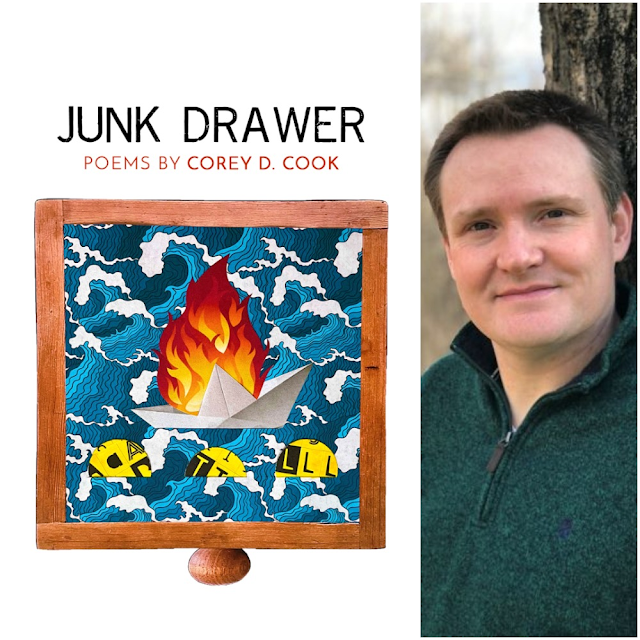
Good afternoon Red Eft Review contributors and readers.
I have been meaning to share that my sixth chapbook, Junk Drawer, has been released and is now available for purchase.
I hope you will consider ordering a copy directly from Finishing Line Press (click here) or from your local bookstore.
Thanks so much and take good care.
-Corey
Tuesday, February 22, 2022

View from Above by M.J. Iuppa
Smokestacks, against skyline, thick gray smoke raining
the ash of a hundred years ago, falling upon brick houses
*
She sits at her kitchen window, high above Niagara, eating
a spoonful of red raspberry jam; watching afternoon dissolve
*
Intermittently, merchant ships blast their horns, making slow
passage on a canal to Ontario, heading north to the sea
*
By dark, she presses her forehead against the screen, wondering
what she has failed to see in the wake of so many things leaving
M.J. Iuppa’s fifth full-length poetry collection The Weight of Air is forthcoming from Kelsay Books in May of 2022. For the past 33 years, she has lived on a small farm near the shores of Lake Ontario. Check out her blog: mjiuppa.blogspot.com for her musings on writing, sustainability and life’s stew.
Monday, February 21, 2022
Sometimes in Winter by M.J. Iuppa
December, late afternoon, dusting of snow, I
stand on the soft shoulder of the two-lane
road, with my back to the sun’s buttery light
that stretches my shadow’s silhouette in-
to a looming cutout of myself, lying
on the frozen grass, looking up at
a peerless sky.
M.J. Iuppa’s fifth full-length poetry collection The Weight of Air is forthcoming from Kelsay Books in May of 2022. For the past 33 years, she has lived on a small farm near the shores of Lake Ontario. Check out her blog: mjiuppa.blogspot.com for her musings on writing, sustainability and life’s stew.
Sunday, February 20, 2022
Commemoration by Melody Wang
On this day celebrating
or reproaching love, I can only
recall each year you were still here,
clutching a fragrant bouquet for mom —
never mind the allergies that flared
even as she, beaming, placed each
one in the dark green sturdy vase
certain to hold the life within
Now she sits in the gloom
of a room that is too cold, empty
nester forced to befriend the shadows
and suppress the urge to burrow
into small cracks, senses heightened
with the absence of those fragrant
bouquets that never failed to remind her
of the fullness of home, of you
Melody Wang currently resides in sunny Southern California with her dear husband and wishes it were autumn all year ‘round. Her debut collection of poetry Night-blooming Cereus was released in December 2021 with Alien Buddha Press. She can be found on Twitter @MelodyOfMusings or at her website https://linktr.ee/MelodyOfMusings
Saturday, February 19, 2022
Magpies by Melody Wang
The morning after
we told my mother
she would become
a first-time grandmother,
she sat alone in the garden
relaxing in the early morning sun,
craned her neck up at the huge tree
and spied a feisty pair of magpies
flitting about in a figure 8 — they squawked
out their monastic chants with abandon,
guarded their muddied little nest
tucked away in the groove
of a high branch. She froze,
eyes wide in a bewildered trance
as she suddenly recalled her own
mother so long ago, behind her
braiding my mother's thick hair,
her gentle voice murmuring about
the songs of magpies symbolizing
good news when you need it the most
My mother's smile was tremulous as she sat
in her garden, shrouded by the sweet incense
of memory, palms pressed together to ponder
all the ways we press on towards the light
Melody Wang currently resides in sunny Southern California with her dear husband and wishes it were autumn all year ‘round. Her debut collection of poetry Night-blooming Cereus was released in December 2021 with Alien Buddha Press. She can be found on Twitter @MelodyOfMusings or at her website https://linktr.ee/MelodyOfMusings
Friday, February 18, 2022
Cotton Fields by C.W. Bigelow
Wandering by cotton fields,
owned by their ancestors,
on their way to crowded church services
to listen to words scripted
2000 years ago.
Current connotations are passed
in code from father to son,
mother to daughter,
values like hereditary cells
morphing malignantly,
continuing a
generational scripture
still inhospitable,
tenacious, secretly
building walls of supremacy.
Like those ancestors
who owned those that slaved
the fields,
roots are deep and rigid
as the white cotton plants.
C.W. Bigelow lives around Charlotte, North Carolina. His fiction and poetry have appeared in Blood & Bourbon, Good Works Review, Backchannels, The Saturday Evening Post, Flash Fiction Magazine, Remington Review, Hare’s Paw, The Write Launch, and Hole in the Head Review with a poem forthcoming in Last Leaves Magazine.
Thursday, February 17, 2022
That Dog by Michelle Meyer
There he is again,
that dog,
the one that wags his tail
and trots out to greet me
because he knows that I am always
carrying a treat.
I call his name
and he runs to me, but
he never follows me.
He knows where home is.
He knows,
as I walk away,
that home is not
with me. He doesn’t love me,
but he likes me.
And I like him too.
We like each other
in the way that seasonal employees
like each other,
able to pick up right where
we left off,
able to say goodbye
without tears.
Michelle Meyer is a hiker, housesitter, and tireless gardener. Her poems have recently appeared, or are forthcoming, in After the Pause, Autumn Sky Poetry Daily, Minnow Literary Magazine, The Talking Stick, Welter (from the University of Baltimore), and Writing in a Woman’s Voice among others.
Wednesday, February 16, 2022
Haiku by Barrie Levine
viewing the viewers
the museum guard’s
job description
Barrie Levine retired from law practice in her seventies and began to avidly read and write haiku. She participates in virtual open mics and teaches a writing class at her senior center. If anyone asks what she does in her retirement, she proudly identifies herself as a haiku poet.
Tuesday, February 15, 2022
Sanding the Driveway by William Doreski
Sanding the driveway at dawn,
I count the elements conspiring
to break my most useful bones.
Ice, snow, a stumbling north wind.
Parodic gestures could undo me,
so I walk so limberly Charlie
Chaplin could have taken lessons.
You watch from the living room
where the cats stretch and critique.
Winter nails its imperatives
as firmly as Martin Luther did.
The unraveled distances ply
snow-spritz and muscular clouds.
Summer houses beside the lake
gasp with loneliness, each room
a study in departed spirits.
Later I’ll walk out on the ice
to hear it boom and crackle.
Two feet thick. No risk of drowning,
although the fish suspended
in semi-hibernation could use
a good laugh, their boredom etched
so deeply on their expressions.
I want to stand in the middle
of that massive optical illusion
and pretend I’m walking on water.
The driveway is drivable again.
The cats applaud with yawns while
you turn away your damp outlook
and return to counting the spoons.
William Doreski lives in Peterborough, New Hampshire. He has taught at several colleges and universities. His most recent book of poetry is Mist in Their Eyes (2021). His essays, poetry, fiction, and reviews have appeared in various journals.
Sunday, February 13, 2022
Haiku by John J. Dunphy
community food pantry
still giving away donated fruitcakes
in February
John J. Dunphy is a haiku poet. His poetry collections include Old Soldiers Fading Away, Zen Koanhead, Stellar Possibilities, pagan rites, Dark Nebulae and Touching Each Tree. He owns The Second Reading Book Shop in Alton, Illinois.
still giving away donated fruitcakes
in February
John J. Dunphy is a haiku poet. His poetry collections include Old Soldiers Fading Away, Zen Koanhead, Stellar Possibilities, pagan rites, Dark Nebulae and Touching Each Tree. He owns The Second Reading Book Shop in Alton, Illinois.
Wednesday, February 9, 2022
Lady Liar by Susan Cossette
Her dialect adapts, depending
on where she is, who she is with,
and how much wine is involved.
Was she born in Boston’s Back Bay,
or in the Bronx,
gazing at jagged potholes
and leftover fast food containers
tossed on the Brucker Expressway?
In high school, she stole Izod socks
out of gym lockers,
cut off the tiny alligators,
sewed them onto her acrylic JC Penney sweaters.
Her gold-knot earrings came from Woolworths,
coated with clear nail polish.
She learned to set a table
and write formal thank-you notes
from books in the public library.
She runs wild, in awe of the atomic tiger lilies
and black-eyed Susans
growing by the highway
on the vast Midwestern plains.
The doctor’s son grew tired of her
antiques, hydrangeas, poetry, and affairs.
Susan Cossette lives and writes in Minneapolis, Minnesota. The author of Peggy Sue Messed Up, she is a recipient of the University of Connecticut’s Wallace Stevens Poetry Prize. A two-time Pushcart Prize nominee, her work has appeared or is forthcoming in Rust and Moth, Vita Brevis, ONE ART, As it Ought to Be, Anti-Heroin Chic, The Amethyst Review, Crow & Cross Keys, Loch Raven Review, and in the anthologies Fast Fallen Women (Woodhall Press) Tuesdays at Curley’s (Yuganta Press), and After the Equinox.
Tuesday, February 8, 2022
Inside the Cloud by Russell Rowland
What to say of this morning’s fog?
When we reached high trailhead,
all was obscured, the hikers phantoms.
A dog barked we couldn’t see.
Driving there, we’d scanned the range
from a distance. One cloud lay
on top of it, like a big fat Merino.
We could get lost in its fleece.
Friends were invisible ten feet away.
It was like being old in a white room.
Or nodding off. Counting down
under anesthesia for the surgeon.
It looked like the last thing you’d see
before dying. But soon enough, day
broke through. We tightened our laces
and went where the sun wanted.
Russell Rowland writes from New Hampshire’s Lakes Region, where he has judged high-school Poetry Out Loud competitions. His work appears in Except for Love: New England Poets Inspired by Donald Hall (Encircle Publications), and Covid Spring, Vol. 2 (Hobblebush Books). His latest book is Wooden Nutmegs (Encircle Publications).
Monday, February 7, 2022
Kayaking by Robert Demaree
1. August 2012
I call the cottagesBy the names of owners past,
My parents’ friends.
There are plastic swans
At Don Queen’s place,
Set out to ward off Canada geese
New to our New Hampshire pond.
I paddle close to shore,
Compiling in my mind
An invasive watercraft index,
Awarding points for those
Powered by hand or wind,
Deductions for inboards,
Jet skis and the like.
I have misjudged the people
In the Campbell house:
They have a kayak after all.
Against the rumble
Of an occasional truck
On the state road
One cannot hear
The fishermen’s trolling motor,
A neutral value on my scale,
As two guys,
Probably from another pond,
Head, as fishermen will,
For the spot,
A gathering place for bass,
That my father loved.
2. September 2014
Cerulean September postcard day,
Breeze six knots or so out of the Northwest:
Two small kayaks put in at the public launch,
A young couple from somewhere else
Setting out to see new vistas on our pond.
I would like to point things out to them:
The tutoring camp where my father taught,
The dam, the inlet where Perry Brook
Ends its narrow run down Copple Crown,
The cottage where we lived
When we first came here—what?—
Nearly seventy summers ago.
I might also ask them if they checked for milfoil.
But they are headed the other way.
I paddle along the west shore,
Past the family of mergansers I saw last week,
Their young still not ready
To set out on their own.
My friend Herb, widowed some years back,
Often sits on his dock alone,
Drinking coffee, reading the paper.
Today, though, he has someone with him,
A woman, I think.
3. Around the Pond
Quiet pond morning in July,
Kayak gliding alongside the past:
A pine tree, now bare, reaches out
Over the shallow bay;
Julys ago our girls
Stood here to pose, then bravely splash
Into the warm, yellow-sand lake, ankle deep.
On the hill we used to climb
The craggy overlook socked in,
Growth of dense green years.
Just as well:
The view we loved now shows
Other hills laid bare for condos.
I paddle home
Against a fresh breeze;
Shoulders that have seen seventy summers
Pull against water heavy with time,
Past the cottages of my father’s friends.
Robert Demaree is the author of four book-length collections of poems, including Other Ladders, published in 2017 by Beech River Books. His poems have received first place in competitions sponsored by the Poetry Society of New Hampshire and the Burlington Writers Club. He is a retired school administrator with ties to North Carolina, Pennsylvania and New Hampshire. Bob’s poems have appeared in numerous periodicals, including Cold Mountain Review and Louisville Review.
Saturday, February 5, 2022
Regression at the Middle-Age Soiree by Carolynn Kingyens
You're surprised when
Blythe Monk,
your daughter's
soft-spoken preschool teacher
from years ago,
who always smells
of Chanel No.5,
pulls out a sandwich bag
full of neatly-wrapped joints
from her COACH purse.
For a brief moment,
you think she's holding
a bag full of Bang Snaps,
those white, twist-tie
wrapper explosives
you once threw
on the ground with glee
when you were a child,
decades ago.
You reach in and take two
Bang Snap-joints;
one for now,
one for later.
And you think —
This is middle-age
regression
while standing
in the midst
of middle-school parents
at the soiree,
where chardonnay
and sangria keep
flowing for hours.
Your thoughts ruminate:
My husband is sleeping
in the guest room; says
it's because of my snoring.
My daughter hates me.
I get side cramps
every time I bend over
to zip-up my favorite,
black suede boots.
I hate my life.
You can feel your defenses
fall as trees do —
loud and disastrous.
Next, you're flirting
with your widower neighbor
with the meticulous lawn —
the retired, tight-lipped
CIA agent, who jogs
every single day
at the crack of dawn,
no matter the weather.
His self-discipline shames
you.
His self-discipline shames
everyone at the party.
You drink sangria
until your mouth has a
port-wine stain mustache.
You twerk on the widower
with the nice lawn.
You twerk on the soft-spoken
Blythe Monk.
You twerk atop
the breakfast bar
until you fall down —
hard.
More than anything, Carolynn Kingyens writes to ultimately connect. She is the author of two poetry collections, Before the Big Bang Makes a Sound and the recently released Coupling, both published by Kelsay Books. In addition to poetry, she writes essays, book/film reviews, micro/flash fiction and short stories. Her short story "Bye Bye, Miss American Pie" was one of fifteen stories selected by Across the Margin, a Brooklyn arts & culture magazine, for their Best Fiction of 2021 list. Click here to read a book review for Coupling, written by the wonderful poet Sharon Waller Knutson.
Friday, February 4, 2022
Impermanence by Daniel Sklar
Names on lists disappear.
Names on lists are replaced
with other names.
People in these offices
will be different.
Other people will walk
the halls and paths
with important things
on their mind.
Like the books
you read in high school,
things disintegrate.
There are new dreams
of strangers saying things
to one another
like the ones before.
Everything will be new
until it isn't.
It gets easier and easier
to say good-bye to things
like the voices and lights
from other rooms
and the unrest
closing in on love.
Your signal flashes
to the world
like a star long gone.
You look forward to being
a memory which is what
you were in the first place.
Daniel Sklar teaches Creative Writing at Endicott College, and has been published in the Harvard Review, English Journal, Beat Scene, and the New York Quarterly among other journals. His books include Flying Cats, Hack Writer, and Bicycles, Canoes, Drums. He rides a bicycle to work.
Thursday, February 3, 2022
Krapp's Last Tape by Doug Holder
Based on a play by Samuel Beckett
In the end
I became
what was
once a
subject
of my fascination.
An old man
praying over
a tape recorder
of memories,
wincing at
his youthful
pomposity.
In some
dark, dank
room
constantly
trying to edit
the mournful dirge
of things
unsaid,
undone.
To rewind,
to hover
under the sliver
of light
from the disrepair
of a lamp...
to listen
again and again
to that time
she came
to me--
smiled...
and her eyes
finally
let me...
in.
Doug Holder is the founder of the Ibbetson Street Press. He teaches Creative Writing at Endicott College. For years he ran poetry groups for psychiatric patients at McLean Hospital outside of Boston. His latest collection is The Essential Doug Holder: New and Selected Poems.
Wednesday, February 2, 2022
The Old Scholar by William G. Gillespie
Often, he stayed in bed
and labored over his book
about the word obey
in Shakespeare, and its roots
in the Latin audire. Often
he thought about the imperfectness
of things and the endless silence
of death. And when the loudest sound
was his dog pawing for water,
the creaking timber of his home,
the song of a wren,
or his own waning breath,
he tried to remember that the dead,
the obedient, listen perfectly.
William G. Gillespie lives and writes in Brooklyn, NY. His poetry has appeared in The Drunken Canal and is forthcoming in Olney Magazine.
Tuesday, February 1, 2022
Free Falling by Sharon Waller Knutson
As we read the date, May 8, 2009,
in his grandmother’s journal,
the image sticks in our minds
of the long and lanky legs
of our six-foot two son flailing
through the wet Washington
air like the wings of a hapless
heron as he falls thirty feet
and lands with a thud
on the hard concrete pavement.
We can still hear his voice woozy
and wavy as he fights his way
through the anesthesia following
the surgery to repair shattered bones
in his hip and both wrists. I rolled
like they taught me in the military
parachute training or I’d be dead.
We can still see him crawling
on his hands and knees to lift
himself into the truck to drive
his son to school and then sitting
in a wheelchair on the sidelines
as his son hits a homerun
in Little League Baseball.
Do you remember the date
you fell from the roof? we ask
as he calls on his speaker phone
as his weakened wrists
at forty-six steer the rig
through the rush hour
and his hip full of hardware
hurts in the humidity. Nope,
he says, but I can’t complain
since I lived to see my boy
turn twenty-two in May.
Sharon Waller Knutson is a retired journalist who lives in Arizona. She has published several poetry books including My Grandmother Smokes Chesterfields by Flutter Press and What the Clairvoyant Doesn’t Say (to read a book review click here) and Trials & Tribulations of Sports Bob now available from Kelsay Books. Her work has also appeared in One Art, Mad Swirl, The Drabble, Gleam, Spillwords, Muddy River Poetry Review, Verse-Virtual, Your Daily Poem, Red Eft Review and The Song Is…
Sharon's book review of Carolynn Kingyens' poetry collection Coupling was recently published by Across the Margin. Click here to check it out.
Sunday, January 30, 2022
State Regulations by Nick Maurer
I thought about pouring it down the storm
drain on my street. The ocean
harmonizes dark and discordant futures.
Or under night's binding I could pour
the tainted mixture in my neighbor’s large yard.
His fence rattles against lengthening summer winds.
But I’ve left the bucket out there
behind the broken bicycle pump and among
the splintering leaves blown in and crumbling stucco
blown down and cracked terra cotta pots filled
with pests and tares counting on tomorrow’s sun
to evaporate the waste I keep
stirring up, the plans
I have for this bucket.
Nick Maurer received an MFA from UC Irvine. He lives in California. Website: jnmaurer.com
Thursday, January 27, 2022
Blood in a Drought Year by Joe Cottonwood
In a midnight thunderstorm, Jeannie phones
to say a young man pounded on her door
dark and bleeding like a redwing blackbird
so she wrapped his ribs in a sheet.
“Wait a minute. You let him in?”
“Of course! He’s darling!”
Jeannie is 80, still a coquette.
I go next door to Jeannie’s house.
On the floor, drops of blood.
Back yard I find a sheet, scarlet stain.
She won’t let me call the cops.
“He’s the stabbee,” she says. “Not me.”
The oak trees drip but the rain has stopped.
Jeannie shivers hugging her own chest and says
“No matter how badly my body hurts,
nights like this keep me alive.”
Thunderstorms drench the night,
quickly pass. After lightning,
the air is so crisp, so fresh.
We need the rain.
Joe Cottonwood can’t help it. He’s drawn to mountains and a more hardscrabble way of life. From Maryland at the foot of Appalachian ridges, he settled in the Santa Cruz Mountains of California among wildfire and redwoods and the occasional lion.
Wednesday, January 26, 2022
Sunkissed, Listless by Ash Evan Lippert
Pretend I’m here, in the grove, lilac clouds
like sleeping lion’s heads nodding
against blameless green,
breathing. Say: I am here. I am still
nothing.
& now I will embrace the ebb
to thoughtlessness.
A robin sends
light branches shaking purple.
Failing petals may only
fall, paling in the wind like February
snow. Impermanent. Barely
probable.
& where am I really?
In my apartment, too real & bodied & strewn
amongst my sweat-stained
covers. Watching
the evergreens scatter their ever-green,
clover colored light bare
across my blank-stare walls.
Someone help me, I’ve forgotten how to live
here, in my time;
here, where trees reach to the sun,
unashamed of their need.
Ash Evan Lippert is a clay artist and emerging queer poet residing in the South Carolina upstate. Their work has appeared or is forthcoming in Failed Haiku and Euonia Review. They are happily at work on their first novel, and the ongoing project of parenting two "whimsical" cats. To check out more of their work, please pay them a visit http://wanderstruckreverie.wordpress.com/
Tuesday, January 25, 2022
Oldest Son by Al Ortolani
As a boy we had a dog die
about once a year. They ran loose,
each morning leaving the house,
returning at night from wherever
the neighborhood pack took them.
We knew each member of the pack by name,
by their owner’s names,
by their speed, their thievery, their bark.
They chased cars on the county road,
and ate the poisoned meat
the farmers set out for rats.
Dogs were free. By that, I mean
we never paid for a puppy.
They came to us tumble deep
in cardboard boxes. Someone
always had a dog to give away.
A “Free” sign, once painted, was kept
in the garage next to the scrap lumber.
Mother handed me a shovel and the car keys.
She said, go before the others get home.
I used a towel, rubbery with Shinola.
I sunk the spade like my father did,
used my weight to lift the earth.
Al Ortolani is the Manuscript Editor for Woodley Press in Topeka, Kansas, and has directed a memoir writing project for Vietnam veterans across Kansas in association with the Library of Congress and Humanities Kansas. He is a 2019 recipient of the Rattle Chapbook Series Award.
Monday, January 24, 2022
Nearing Sedalia by Al Ortolani
There’s a silo along the highway
with a tree growing out of it, the top
branches splayed across the sky
like an umbrella, like an anemone.
It’s a landmark for us as we drive
across Missouri, as much a mile marker
as a small town, a fishing creek
with an iron bridge, a cemetery
in a children’s game.
We watch for it on the hill
behind the barn, behind the ghost sign
faded across the barn roof:
hickory baskets, walnut bowls, moccasins.
The silo is made from tile bricks,
carefully cemented, the domed roof
of sheet metal and wood collapsed,
blown into the pasture, the sapling
in a cylinder of sun.
Al Ortolani is the Manuscript Editor for Woodley Press in Topeka, Kansas, and has directed a memoir writing project for Vietnam veterans across Kansas in association with the Library of Congress and Humanities Kansas. He is a 2019 recipient of the Rattle Chapbook Series Award.
Sunday, January 23, 2022
Uprooting the Lilac by Al Ortolani
Today, we plant a Limelight hydrangea
in the hole where we dug out the lilac,
where just a month ago, I chopped back
the roots with my garage sale axe.
My wife gave up on it ever flowering,
tall and spindly, spreading
everywhere and nowhere at once.
She gave it seven years to get itself together,
to become a lilac goddammit.
The shovel popped and bent as I pried
the root ball from the earth, the brown
soil, greasy with clay, with shards
of sandstone. The tap root gripped
until it gave, and only the silence held.
Al Ortolani is the Manuscript Editor for Woodley Press in Topeka, Kansas, and has directed a memoir writing project for Vietnam veterans across Kansas in association with the Library of Congress and Humanities Kansas. He is a 2019 recipient of the Rattle Chapbook Series Award.
Saturday, January 22, 2022
Bingo Faith by Ellen Skilton
What if loftiness is a false flower —
and the church’s real purpose is
bingo faith, not sanctuary salvation?
My grandmother was a prophet
of generosity, her cash creed:
You don’t win if you don’t give it away.
Much more than mad money,
her profits from games of chance
were pillars of her ballsy beliefs.
She’d quietly teach me her own
moral code, whispering of her best friend:
She never wins because she keeps it all.
Once, I saw her use her own shoe
to create a secret stain and a righteous
discount on an overpriced baby hat.
In the early 80’s, when I had big hair,
born-again friends told me this scorching untruth:
Your grandmother is going to hell.
These Saturday-bingo-grandmas
that don’t pray in pews get tut-tutting from
Sunday-church-goers so damn sure they’re blessed.
They are all wrong. Helen’s holiness shined
in bright kitchen light, adding up winnings
and givings in her flowered, cotton housedress.
Ellen Skilton is a professor of education whose creative writing has appeared in The Dewdrop, Cathexis Northwest Press, The Scapegoat Review, and The Dillydoun Review. She is also an excellent napper, a chocolate snob, a swimmer, and lives in Philadelphia with a dog named Zoomer, a cat named Katniss and some lovely humans.
Wednesday, January 19, 2022
The Chapel by Brandon McQuade
In the quiet hours
the wind howls
and the snow drifts
like mountains.
The fire burning
in the hearth
of the chapel,
in the heart
of birch and frost
is not lost
on this wilderness.
These are the keys
to our survival
and comfort—
necessary fragments
of our domestic,
modern world:
knife, tent, firestarter,
pen and paper, a good book
and a sack lunch—
companions we carry with us
like torches into the wild.
Brandon McQuade is the founding editor of Duck Head Journal. His debut chapbook, Bleeding Heart was published by Kelsay Books (2021) and is available on Amazon. His debut collection, Mango Seed, is forthcoming with Scurfpea Publishing. He lives in Gillette, Wyoming with his wife, Jacqlyn and their children.
Saturday, January 15, 2022
Between Us by Deirdre Fagan
My husband takes the dog along
to gather the mail.
His grey matching winter’s muzzle,
a retriever seamlessly blending into snow.
The walk to the box is as long as a meadow;
a city block to remember from whence he came.
Once, there was no dog, no country home,
only letters through a slit in the door.
Four bedrooms, one occupied—no children,
no wife.
We are nearly ten years into this game—
we’re still playing.
But that’s not what he’s thinking as I eye
him from the window—the dog flanking his calves.
It’s the distance that excites, it’s the return;
it’s the marrow between us.
Deirdre Fagan is a widow, wife, mother of two and associate professor at Ferris State University. Fagan is the author of the memoir Find a Place for Me (forthcoming, 2022), a collection of short stories, The Grief Eater (2020), and a poetry chapbook, Have Love (2019). Meet her at deirdrefagan.com
Friday, January 14, 2022
Arlington Racetrack by Jason Fisk
I used to want to spend
my summers
at the horse track
writing about the characters
I would see there
but I never got around to it
Now the track has
permanently closed
and I’m stuck writing
mediocre poems
about failed plans
to write great poems
Jason Fisk lives and writes in the suburbs of Chicago. He has worked in a psychiatric unit, labored in a cabinet factory, and mixed cement for a bricklayer. He was born in Ohio, raised in Minnesota, and has spent the last few decades in the Chicago area. He has a novel, The Craigslist Incident, coming out in June. www.jasonfisk.com
Thursday, January 13, 2022
Ghost Garden by Jason Fisk
She lived alone in the middle part of the country
In a little blue ranch house with white trim
She loved her family and her garden
The grandkids helped her weed
when they visited from out of state
She would reward them
with cinnamon candy
and iced tea
She used to straighten the house
every night before bed
I once asked her why
and she told me
that it was for the paramedics
She didn’t want them
to see a dirty house
when they came
to take her away
She told me that she
was just waiting
to go be reunited
with Grandpa Earl
in heaven
After her funeral
I went to the blue house
and walked inside
It was clean
which made me smile
I walked to the back
and opened the sliding glass door
and saw her garden
The overgrowth reminded me
of how long it had been since I’d visited
An aching loss churned in my stomach
And then I noticed a sweet little rosebud
peeking through the purple and green
of the inhospitable thistle
and I started pulling
the weeds away
from the base of the rose
My arms and hands torn
by the various thorns
It somehow felt right
I went into the garage
and got a shovel
and a bucket
and I dug the rose up
and put it in the bucket
I drove to her new grave
and planted it
where I imagined
her heart would be
Jason Fisk lives and writes in the suburbs of Chicago. He has worked in a psychiatric unit, labored in a cabinet factory, and mixed cement for a bricklayer. He was born in Ohio, raised in Minnesota, and has spent the last few decades in the Chicago area. He has a novel, The Craigslist Incident, coming out in June. www.jasonfisk.com
Monday, January 10, 2022
Winter Birds by Jack Powers
I keep thinking they missed their cue,
seduced by some false November sun
and now suffering for their sins.
Such scrawny legs and feet, translucent claws!
Yet they seem to survive: chickadee, junco
nuthatch, cardinal. These birds of winter searching
for seeds, spiders, tree buds, fluffing their feathers
for warmth–alone, in pairs or flocks
that litter my yard or string themselves
in black rosaries across the sky.
In a blizzard they disappear, huddling,
I hope, in hedges, the downwind side of trees.
In the morning sun, a nuthatch flutters in a backyard fir,
tooting his horn like an answered prayer.
Jack Powers is the author of Everybody's Vaguely Familiar. His poems have appeared in The Southern Review, The Cortland Review, Inkwell and elsewhere. He won the 2015 and 2012 Connecticut River Review Poetry Contests and was a finalist for the 2013 and 2014 Rattle Poetry Prizes. Visit his website: http://www.jackpowers13.com/poetry/.
Subscribe to:
Posts (Atom)